
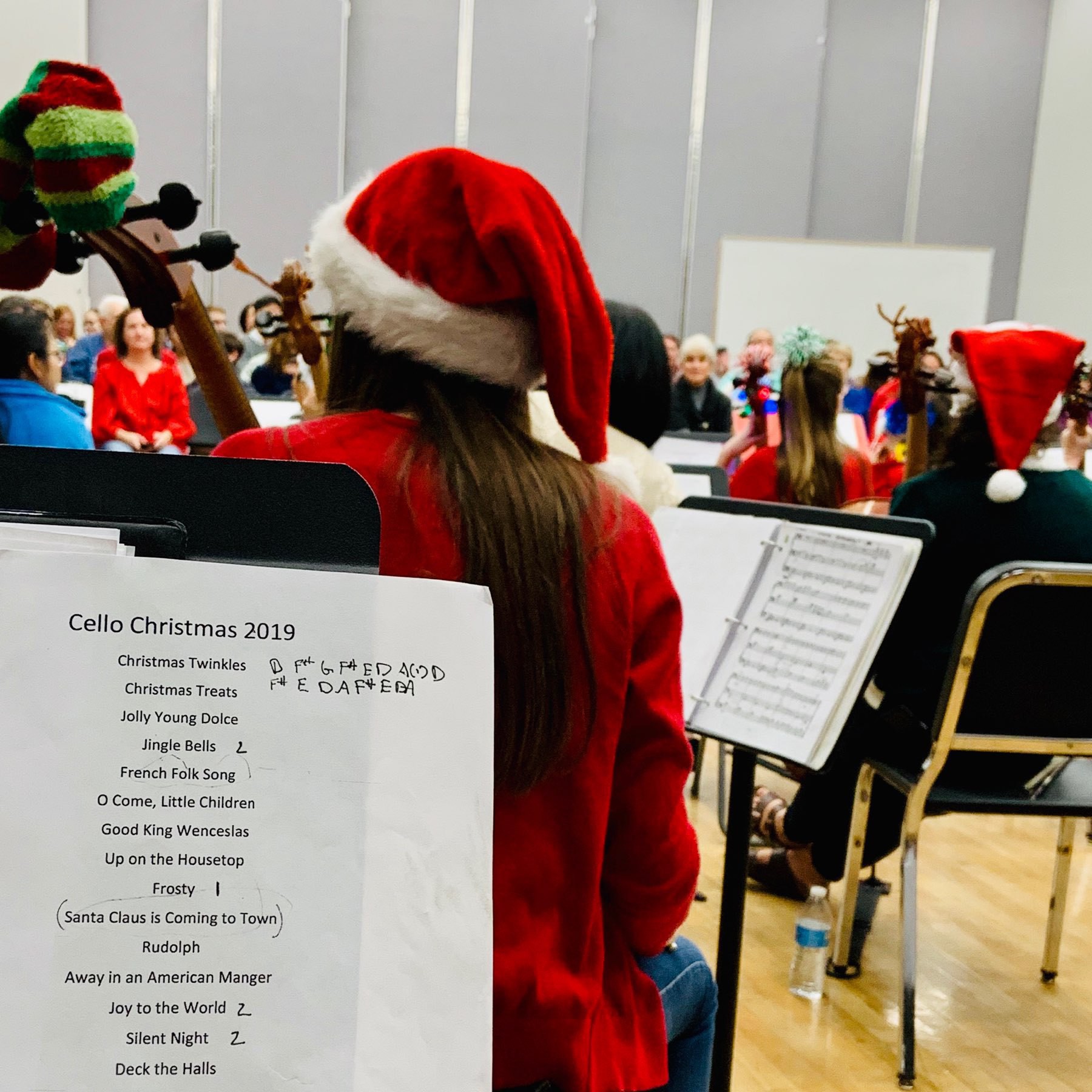
Last Saturday I went to Cello Christmas 2019 hosted by super-teacher Mary Beth Tyndall. About 40 cellists playing Christmas tunes, a scroll decorating contest, and lots of smiles.
John Calvin: music is “a gift of God”
“…among the other things which are appropriate to recreate man and give him desire, music is either the first or on the the chief ones, and we must deem it to be a gift of God intended for this use.”
From a letter he wrote about worship.
I read Music, Singing, and Emotions: Exploring the Connections in Themelios. What a great essay.
Someone should write a Christmas carol based on Rev 21:16 and call it Angles from the Realms of Glory.

Peter King has written a top-shelf article on Thomas Aquinas’s view of emotions. This is my summary of some of his key findings.
What is an emotion?
Thomas Aquinas believed that emotion is “a semi-autonomous faculty of the soul”. An emotion is something the soul experiences, not something the soul does.
Emotions are reactions you experience when you perceive something. This apprehension of a thing can happen either mentally or physically. A person, for example, can feel joy either by imagining chocolate or by tasting chocolate.
Emotions are reactions, but they can also cause things too. Fear can motivate you to run. It can also make your teeth chatter.
Can we control our emotions?
Although an emotion is a reaction, that is, something causes it, Aquinas thinks we have some control over the emotions we experience. Emotion “is not completely in our power since it precedes the judgment of reason," but “it is in our power to some extent.” King suggests that in this way, emotion is like sight. You can only see what you see, but you can also direct your eyes to look at something. This means that the experience of an emotion or the power of an emotion can be somewhat what controlled (i.e. willed).
One way we control our emotions is through thinking and reasoning. This is because how we interpret things can affect how we feel. Imagine you see a large dog and become afraid. You are afraid because you interpret his size as a danger to you. But if you discover that the dog is a therapy dog used in hospitals to calm children, your fear may change into a desire to pet him. The dog has not changed, only your understanding of the dog. And because your understanging has changed, your feelings have followed. If it only it were always this easy!
How many emotions are there?
Sometimes, we talk about emotion in terms of movement. “I feel love toward my wife,” for example. Borrowing from physics, Aquinas thinks about all emotions as types of movement directed towards good or evil.
Aquinas identifies eleven main emotions. The emotions directed toward what we perceive as good are love, desire, hope, despair, and joy. Emotions directed toward what we perceive as evil are hate, aversion, confidence, fear, sorrow, and anger.
Emotions directed toward (perceived) good
- Love is the emotional stance we have toward something good.
- Desire is the emotional pull we have toward something good.
- Hope is the emotional stance we have for a difficult but attainable good.
- Despair is the emotional stance we have for a difficult but unattainable good.
- Joy is the emotion of having attained something good.
Emotions directed toward (perceived) evil
- Hate is the emotional stance we have toward something evil.
- Aversion is the emotional push we have away from something evil.
- Confidence is the emotional stance we have toward an avoidable evil.
- Fear is the emotional stance we have toward an unavoidable evil.
- Sorrow is the emotion of having attained something evil.
- Anger is the emotion of having attained a difficult or even insurrmountable evil.
Notice the pairs, except for anger, which is unique. Read King’s article to understand why.
An old man named Zecharaiah is filled with the Holy Spirit. He prophesies about the miraculous births of two children: one his son, the other his Savior. And he blesses God. For hope is on the way.
But it it is not a new hope, it is the fully flowered hope of old…
“This flow’r, whose fragrance tender with sweetness fills the air, dispels with glorious splendor the darkness everywhere. True man, yet very God, from sin and death he saves us and lightens every load.” — Lo, How a Rose E’er Blooming
These are among the many lovely and mysterious things we Christians will consider tomorrow when come together to worship God. If you don’t yet enjoy the hope of God in these things, consider joining us at Covenant, or anywhere that Christ is preached.
This is entry 2 of the blogchain Better Leading, Better Meeting.
At the most general level, any good book on leadership will give you insights that you can apply to meetings. At the most specific level, you’ll find resources that share advice for specific kinds of meetings such as family worship, coaching, or teaching. For organizational meetings, Lucid Meetings has created an insightful taxonomy of organizational meetings and offers advice on each kind.
In between these two levels of guides are books that focus on meetings but in a more general way. These books are where you ought to start. They provide advice for any gathering and a framework into which more specific advice can fit.
If you’re not in a hurry, start with The Art of Gathering: How We Meet and Why It Matters by Private Parker.1 It’s very good. If you have an important meeting soon and need some advice and right now, skim Let’s Stop Meeting Like This: Tools to Save Time and Get More Done by Dick and Emily Axelrod,2 and then study it later as soon as you can. If if your meeting is tomorrow, the Economist summarizes the most important points in How to Lead Better Meetings.
Finally, I recommend Five Gears: How to Be Present and Productive When There Is Never Enough Time by Jeremie Kubicek and Steve Cockram.3 It’s not directly about meetings, but it provides basic categories for thinking about the different ways we spend time with others.
Not all learning, however, comes from books. Nothing can replace serving with and under leaders who can show you the way you want to go and are the kind of person you want to be. Leaders like this have blessed me beyond what I can say.
-
Find The Art of Gathering on Worldcat. ↩︎
-
Find Let’s Stop Meeting Like This on Amazon. ↩︎
-
Find Five Gears on Worldcat. ↩︎